

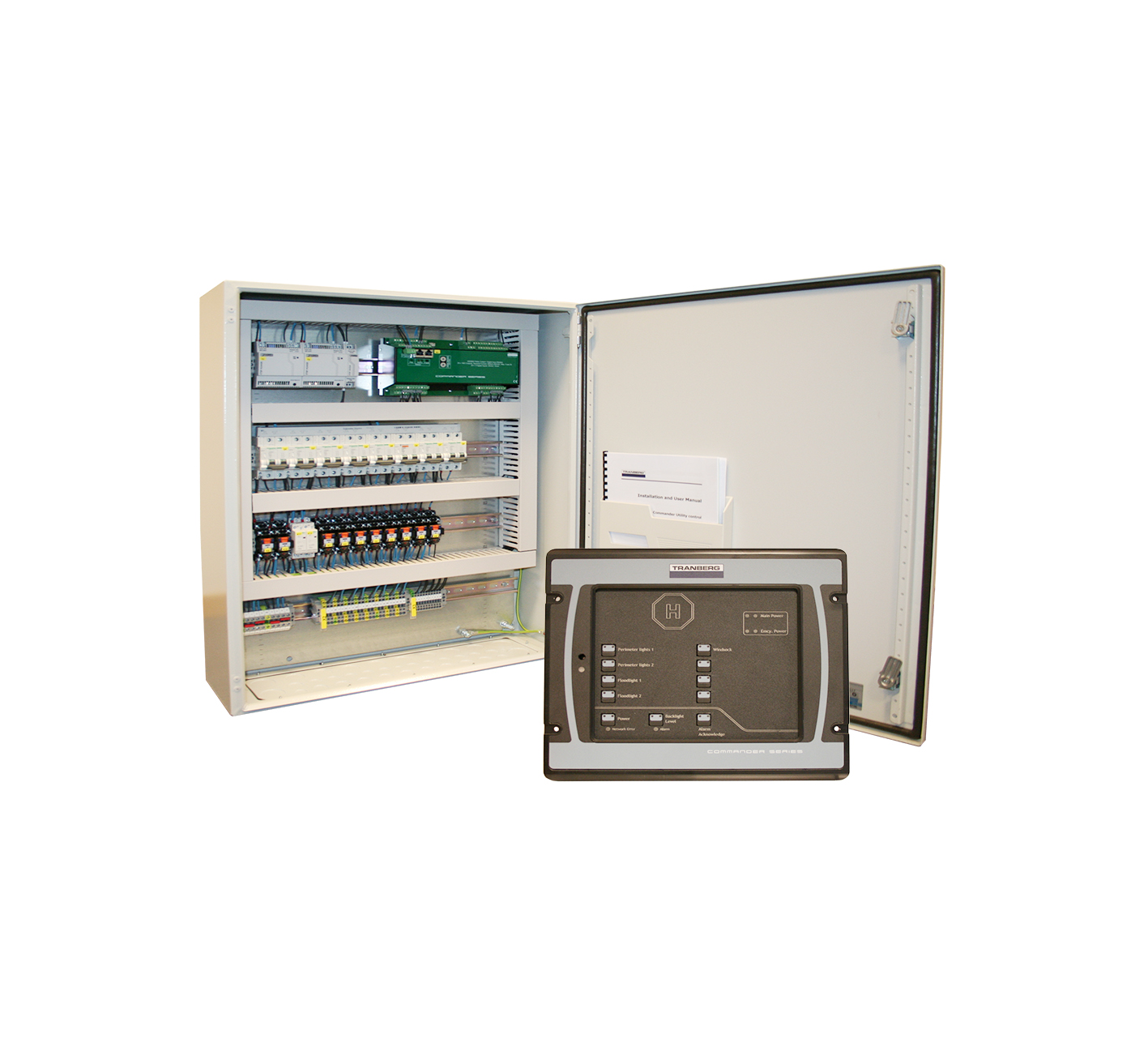


The TRANBERG® TEF 4500 Commander Utility is a ready-to-install helideck lights control system (HLCS) for safe areas: a pre-wired enclosure with eight outgoing circuits and a compact push-button panel for the bridge or the radio room, connected by a single RS-485 cable. The panel controls perimeter lights, floodlights and windsock lights on eight illuminated buttons, with main power, alarm acknowledge and backlight dimming, and three spare buttons for circuits added later. Up to seven panels share the network, so the lights can be controlled and monitored from several locations at once. Developed and manufactured at our own factory.
Application
- Control system for deck lights, floodlights and windsock lights on helidecks in safe areas
- Offshore platforms, FPSOs, drilling units, supply vessels and onshore heliports
Features and benefits
- Ready for installation: control panel and enclosure with 8 outgoing circuits, B10A, complete
- Panel may be mounted far from the enclosure; up to 7 panels on the RS-485 network
- Dual power with automatic changeover to the emergency source according to DNV Pt. 6 Ch. 1 Sec. 2 F503
- Common alarm on circuit breakers, Naut-OSV alarm signalling to the bridge alarm system (BAMS): buzzer and flashing LED on the panel, volt-free Bridge Alarm Relay, acknowledge from the panel or by 24 V DC input, Bridge Alarm Reset relay
- Optional gateway for two-way communication with an external system (NMEA-0183 or proprietary); three extra contactors and circuit breakers available; customer-specific button text
Technical data (TPS4503)
| Incoming power | 220–240 V AC 50/60 Hz, main and emergency supply (must match the luminaires) |
|---|---|
| Outputs | 8 outgoing circuits, B10A; relay module 24 × NO outputs 500 mA 250 V AC |
| Control panel | 254 × 225 × 60 mm, 1.5 kg, IP22 |
| Enclosure | 600 × 760 × 210 mm, 48 kg, IP66 |
| Communication | RS-485 between enclosure and panels, twisted pair |
| Alarm | One alarm input, Bridge Alarm Relay and Bridge Alarm Reset relay, acknowledge input 24 V DC |
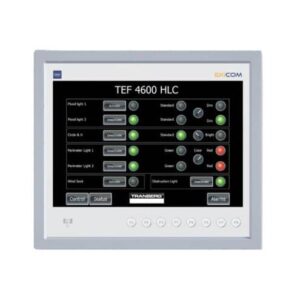
Options in the datasheet: additional control panel 4500704, gateway module 4500800 and local Ex helideck lights control panel 4500901. Drawings 460A108487/460A108488 and the termination diagram are listed above the table. For touch-panel control of all light types including Circle & H and status lights, or for Zone 1, see the TEF 4600.